
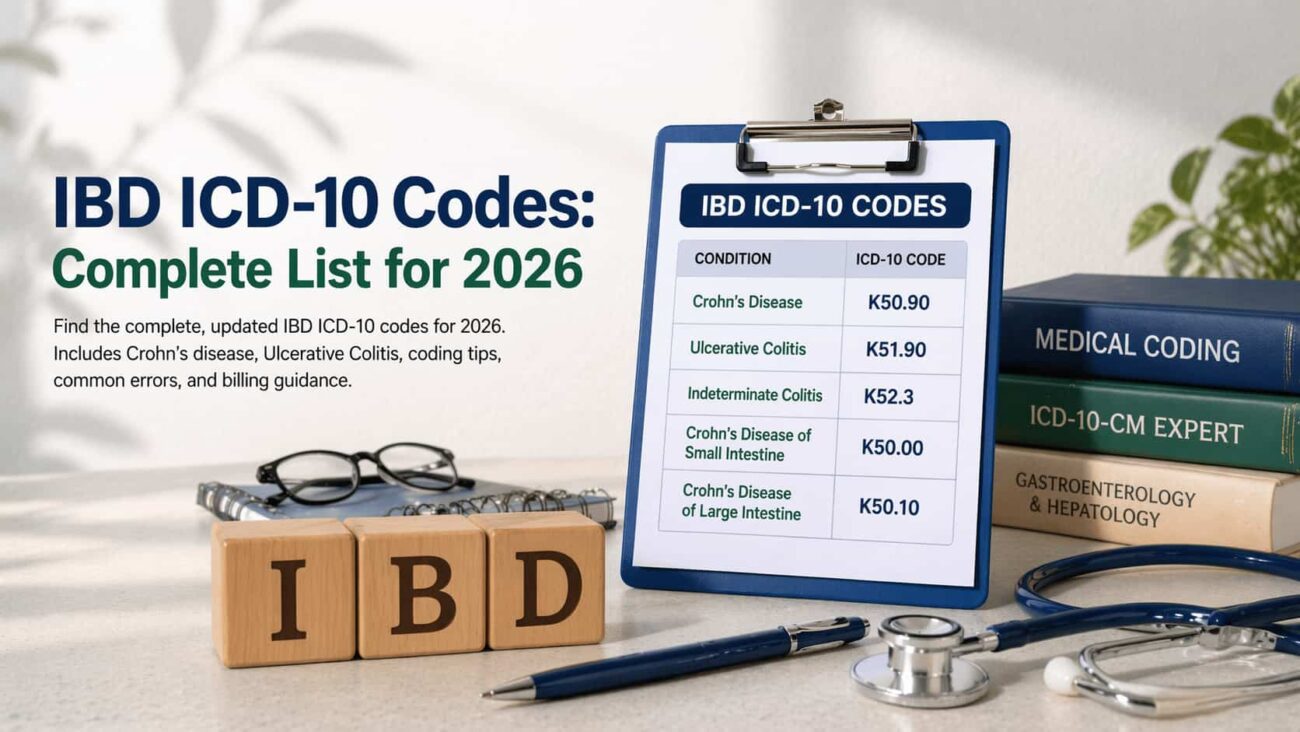
IBD ICD-10 Codes: Complete List for Crohn’s Disease, Ulcerative Colitis & Related Conditions (2026)
If you’ve ever stared at a billing screen trying to find the right IBD ICD-10 code — or received a claim denial because you used an unspecified code when a specific one existed — this guide was written for you.
Inflammatory bowel disease (IBD) is not a single condition. It’s a family of chronic gastrointestinal diseases — primarily Crohn’s disease and ulcerative colitis — each with dozens of ICD-10 subcodes that reflect disease location, activity, and complications. Using the wrong code means delayed reimbursement, denied claims, and inadequate documentation of disease severity.
This is the most complete, clinically organized reference for IBD ICD-10 codes available — built for gastroenterologists, nurses, medical coders, billing staff, and patients who want to understand their own records.
IBD ICD-10 codes fall under two primary categories in the ICD-10-CM system: K50 (Crohn’s disease / regional enteritis) and K51 (Ulcerative colitis). Each category branches into subcodes based on anatomical location and complications such as rectal bleeding, obstruction, fistula, and abscess. Selecting the most specific code available is required for accurate medical billing and documentation.
What Are ICD-10 Codes and Why Do They Matter for IBD?
The International Classification of Diseases, 10th Revision, Clinical Modification (ICD-10-CM) is the standardized coding system used across the United States healthcare system to document diagnoses, conditions, symptoms, and medical procedures.
For IBD patients and providers, ICD-10 codes do far more than facilitate billing:
- Insurance coverage: Payers use codes to determine medical necessity and authorize treatments, specialist referrals, and biologic medications.
- Clinical documentation: The code selected must accurately reflect disease severity, location, and active complications — which influences treatment decisions.
- Research and epidemiology: ICD-10 codes power public health databases that track IBD prevalence, treatment outcomes, and complication rates nationally.
- Prior authorizations: Biologic therapies (infliximab, vedolizumab, ustekinumab) often require specific complication codes to justify medical necessity.
- Disability and legal documentation: Accurate IBD coding supports FMLA claims, disability applications, and accommodation requests.
IBD ICD-10 Codes: Understanding the Structure
Every ICD-10-CM code follows a predictable alphanumeric structure. For IBD codes, here’s how to read them:
- K50 = Crohn’s disease (regional enteritis) — the root category
- K50.0 = Crohn’s disease of the small intestine
- K50.01 = Crohn’s disease of the small intestine with complications
- K50.011 = Crohn’s disease of the small intestine with rectal bleeding
- The 5th and 6th digits specify the complication type
The last digit in the IBD code series almost always signals the complication:
- 0 = Without complications
- 1 = With rectal bleeding
- 2 = With intestinal obstruction
- 3 = With fistula
- 4 = With abscess
- 8 = With other specified complication
- 9 = With unspecified complications
Understanding this structure means you can navigate any IBD code intuitively — without memorizing every individual code.
Complete ICD-10 Code List: Crohn’s Disease (K50)
Crohn’s disease (also known as regional enteritis) can affect any part of the GI tract from mouth to anus, but it most commonly involves the terminal ileum and large intestine. The ICD-10 system organizes Crohn’s codes by anatomical location first, then by complication.
| ICD-10 Code | Description |
|---|---|
| K50.00 | Crohn’s disease of small intestine without complications |
| K50.011 | Crohn’s disease of small intestine with rectal bleeding |
| K50.012 | Crohn’s disease of small intestine with intestinal obstruction |
| K50.013 | Crohn’s disease of small intestine with fistula |
| K50.014 | Crohn’s disease of small intestine with abscess |
| K50.018 | Crohn’s disease of small intestine with other complication |
| K50.019 | Crohn’s disease of small intestine with unspecified complications |
| ICD-10 Code | Description |
|---|---|
| K50.10 | Crohn’s disease of large intestine without complications |
| K50.111 | Crohn’s disease of large intestine with rectal bleeding |
| K50.112 | Crohn’s disease of large intestine with intestinal obstruction |
| K50.113 | Crohn’s disease of large intestine with fistula |
| K50.114 | Crohn’s disease of large intestine with abscess |
| K50.118 | Crohn’s disease of large intestine with other complication |
| K50.119 | Crohn’s disease of large intestine with unspecified complications |
| ICD-10 Code | Description |
|---|---|
| K50.80 | Other Crohn’s disease without complications |
| K50.811 | Other Crohn’s disease with rectal bleeding |
| K50.812 | Other Crohn’s disease with intestinal obstruction |
| K50.813 | Other Crohn’s disease with fistula |
| K50.814 | Other Crohn’s disease with abscess |
| K50.818 | Other Crohn’s disease with other complication |
| K50.819 | Other Crohn’s disease with unspecified complications |
| ICD-10 Code | Description |
|---|---|
| K50.90 | Crohn’s disease, unspecified, without complications |
| K50.911 | Crohn’s disease, unspecified, with rectal bleeding |
| K50.912 | Crohn’s disease, unspecified, with intestinal obstruction |
| K50.913 | Crohn’s disease, unspecified, with fistula |
| K50.914 | Crohn’s disease, unspecified, with abscess |
| K50.918 | Crohn’s disease, unspecified, with other complication |
| K50.919 | Crohn’s disease, unspecified, with unspecified complications |
Complete ICD-10 Code List: Ulcerative Colitis (K51)
Unlike Crohn’s disease, ulcerative colitis is always confined to the colon and rectum. The K51 codes are organized by the extent of colonic involvement — from proctitis (rectum only) to pancolitis (entire colon).
| ICD-10 Code | Description |
|---|---|
| K51.00 | Ulcerative (chronic) pancolitis without complications |
| K51.011 | Ulcerative (chronic) pancolitis with rectal bleeding |
| K51.012 | Ulcerative (chronic) pancolitis with intestinal obstruction |
| K51.013 | Ulcerative (chronic) pancolitis with fistula |
| K51.014 | Ulcerative (chronic) pancolitis with abscess |
| K51.018 | Ulcerative (chronic) pancolitis with other complication |
| K51.019 | Ulcerative (chronic) pancolitis with unspecified complications |
| ICD-10 Code | Description |
|---|---|
| K51.20 | Ulcerative (chronic) proctitis without complications |
| K51.211 | Ulcerative (chronic) proctitis with rectal bleeding |
| K51.212 | Ulcerative (chronic) proctitis with intestinal obstruction |
| K51.213 | Ulcerative (chronic) proctitis with fistula |
| K51.214 | Ulcerative (chronic) proctitis with abscess |
| K51.218 | Ulcerative (chronic) proctitis with other complication |
| K51.219 | Ulcerative (chronic) proctitis with unspecified complications |
| ICD-10 Code | Description |
|---|---|
| K51.30 | Ulcerative (chronic) rectosigmoiditis without complications |
| K51.311 | Ulcerative (chronic) rectosigmoiditis with rectal bleeding |
| K51.312 | Ulcerative (chronic) rectosigmoiditis with intestinal obstruction |
| K51.313 | Ulcerative (chronic) rectosigmoiditis with fistula |
| K51.314 | Ulcerative (chronic) rectosigmoiditis with abscess |
| K51.318 | Ulcerative (chronic) rectosigmoiditis with other complication |
| K51.319 | Ulcerative (chronic) rectosigmoiditis with unspecified complications |
| ICD-10 Code | Description |
|---|---|
| K51.40 | Inflammatory polyps of colon without complications |
| K51.411 | Inflammatory polyps of colon with rectal bleeding |
| K51.412 | Inflammatory polyps of colon with intestinal obstruction |
| K51.413 | Inflammatory polyps of colon with fistula |
| K51.414 | Inflammatory polyps of colon with abscess |
| K51.418 | Inflammatory polyps of colon with other complication |
| K51.419 | Inflammatory polyps of colon with unspecified complications |
| ICD-10 Code | Description |
|---|---|
| K51.50 | Left-sided colitis without complications |
| K51.511 | Left-sided colitis with rectal bleeding |
| K51.512 | Left-sided colitis with intestinal obstruction |
| K51.513 | Left-sided colitis with fistula |
| K51.514 | Left-sided colitis with abscess |
| K51.518 | Left-sided colitis with other complication |
| K51.519 | Left-sided colitis with unspecified complications |
| ICD-10 Code | Description |
|---|---|
| K51.80 | Other ulcerative colitis without complications |
| K51.811 | Other ulcerative colitis with rectal bleeding |
| K51.812 | Other ulcerative colitis with intestinal obstruction |
| K51.813 | Other ulcerative colitis with fistula |
| K51.814 | Other ulcerative colitis with abscess |
| K51.818 | Other ulcerative colitis with other complication |
| K51.819 | Other ulcerative colitis with unspecified complications |
| ICD-10 Code | Description |
|---|---|
| K51.90 | Ulcerative colitis, unspecified, without complications |
| K51.911 | Ulcerative colitis, unspecified, with rectal bleeding |
| K51.912 | Ulcerative colitis, unspecified, with intestinal obstruction |
| K51.913 | Ulcerative colitis, unspecified, with fistula |
| K51.914 | Ulcerative colitis, unspecified, with abscess |
| K51.918 | Ulcerative colitis, unspecified, with other complication |
| K51.919 | Ulcerative colitis, unspecified, with unspecified complications |
IBD-Related ICD-10 Codes You Also Need to Know
IBD doesn’t exist in isolation. Patients often require additional codes to capture the full clinical picture — extra-intestinal manifestations, nutritional consequences, and procedural diagnoses all carry their own codes.
Indeterminate Colitis
When pathology cannot clearly distinguish Crohn’s from UC — which happens in roughly 10–15% of IBD cases — the appropriate code is:
| ICD-10 Code | Description |
|---|---|
| K52.3 | Indeterminate colitis |
IBD Extra-Intestinal Manifestations
Up to 40% of IBD patients develop complications outside the gut. These require separate secondary codes:
| ICD-10 Code | Description |
|---|---|
| M07.60 | Enteropathic arthropathy, unspecified site (IBD-related joint disease) |
| L52 | Erythema nodosum (IBD-related skin manifestation) |
| H20.00 | Unspecified anterior iridocyclitis (IBD-related uveitis) |
| K83.01 | Primary sclerosing cholangitis (liver complication in UC) |
| M81.0 | Age-related osteoporosis (bone loss from corticosteroid use) |
| D50.0 | Iron deficiency anemia secondary to blood loss (chronic) |
| E41 | Nutritional marasmus (severe malnutrition in IBD) |
IBD-Related Surgical and Procedural Codes
| ICD-10 Code | Description |
|---|---|
| Z93.3 | Colostomy status (post-surgical stoma) |
| Z93.2 | Ileostomy status |
| Z96.89 | Presence of other specified functional implants (J-pouch) |
| Z87.19 | Personal history of other digestive system diseases |
Toxic Megacolon
| ICD-10 Code | Description |
|---|---|
| K59.31 | Toxic megacolon (life-threatening complication of UC) |
Patients managing IBD often experience significant changes in gut microbiome composition, which can worsen inflammatory activity and complicate symptom management. Understanding the relationship between gut bacteria and disease flares is increasingly important. Our overview of probiotic side effects is valuable reading for anyone with IBD considering supplementation alongside their prescribed therapy.
How to Choose the Right IBD ICD-10 Code: Step-by-Step
Selecting the correct code from dozens of options requires a systematic approach. Here’s the framework that experienced gastroenterology coders use:
- Confirm the diagnosis type: Is this Crohn’s disease (K50) or ulcerative colitis (K51)? If unclear — use K52.3 (indeterminate colitis).
- Identify the anatomical location: For Crohn’s — small intestine (K50.0), large intestine (K50.1), both (K50.8), or unspecified (K50.9). For UC — check the extent: proctitis, rectosigmoid, left-sided, or pancolitis.
- Identify active complications: Review the clinical notes, lab results, and imaging for documentation of rectal bleeding, obstruction, fistula, or abscess. Each requires a specific 6th-digit code.
- Check for “with” vs “without” complications: If no complications are documented, use the “without complications” code (e.g., K50.00). Do not assume complications — they must be documented.
- Add secondary codes: Capture extra-intestinal manifestations, nutritional deficiencies, anemia, and post-surgical status as secondary diagnoses.
- Verify with the Official Coding Guidelines: The USGPO publishes annual ICD-10-CM guidelines — always check Section I.C.1 and the “Code First” / “Use Additional Code” instructions within the Tabular List.
The 6 Most Common IBD Coding Errors — and How to Avoid Them
- Using unspecified codes when specifics are documented. If the endoscopy report says “terminal ileitis consistent with Crohn’s disease,” K50.90 (unspecified) is incorrect. K50.00 or the appropriate complication subcode is required.
- Missing secondary complication codes. A patient hospitalized for Crohn’s disease with an abscess and anemia needs both K50.014 and D50.0. Capturing only the primary IBD code leaves revenue and clinical data on the table.
- Confusing left-sided colitis with rectosigmoiditis. Left-sided colitis (K51.5) extends to the splenic flexure. Rectosigmoiditis (K51.3) is limited to the rectum and sigmoid. The colonoscopy report must specify extent of disease.
- Applying a “history of” code during active disease. Z87.19 (personal history of digestive disease) is for remission documentation only. During active disease, use the active IBD code.
- Failing to update codes after disease progression. A patient previously coded as ulcerative proctitis (K51.20) whose disease has extended to left-sided colitis should now be coded as K51.50. Codes must reflect current clinical status.
- Using an IBD code without documenting the diagnostic basis. Payers require that IBD codes be supported by histological confirmation (biopsy) or definitive endoscopic and imaging findings. “Rule out” or “probable” diagnoses should not carry IBD codes in outpatient settings.
IBD, the Gut Microbiome, and Why It Matters Beyond Coding
For patients and families reading this guide, the ICD-10 codes above represent something far more personal than billing numbers — they document a chronic, life-altering condition. Understanding how IBD interacts with gut health can help you ask better questions and make more informed decisions alongside your gastroenterologist.
Research has consistently shown that both Crohn’s disease and ulcerative colitis are associated with significant disruption of the gut microbiome — the ecosystem of bacteria that line the intestinal wall. Key protective species like Faecalibacterium prausnitzii are often depleted, while pro-inflammatory bacteria are elevated.
Probiotic supplementation as an adjunct to IBD therapy is an active area of research. While not a substitute for prescription medications, specific strains may help maintain remission in ulcerative colitis. If you’re managing IBS symptoms alongside IBD, our comprehensive guide to the best probiotics for IBS covers which strains have the strongest clinical support.
Bloating and abdominal discomfort are daily realities for many IBD patients, even during remission. Our evidence-based review of the best probiotics for bloating offers practical guidance on targeted gut support.
For a broader understanding of how the gut microbiome is supported through dietary intervention, our guide comparing probiotics vs prebiotics explains the distinct roles of each — and how both may benefit people with chronic gut inflammation.
Authoritative Resources for IBD ICD-10 Coding
Coding guidelines change annually. To ensure your IBD codes are current and compliant, consult these official sources:
- Centers for Medicare & Medicaid Services (CMS) ICD-10 Resources — The official annual ICD-10-CM tabular lists, addenda, and coding guidelines updated every October 1st.
- Crohn’s & Colitis Foundation IBD Insurance Resource Center — Patient-focused guidance on IBD insurance coverage, prior authorizations, and advocacy tools.
Frequently Asked Questions
Conclusion: Accurate IBD ICD-10 Coding Is a Clinical Responsibility
Getting IBD ICD-10 codes right is not a bureaucratic exercise — it directly affects patient care, insurance access, treatment authorization, and long-term disease documentation. A code selected without considering anatomical location, complications, or clinical status tells an incomplete story that can result in denied claims, undertreated disease, and gaps in epidemiological data.
The K50 and K51 code families are built around a logical framework once you understand the structure: category → location → complication type. Master that hierarchy and you can navigate any IBD coding scenario with confidence.
For providers: audit your top IBD codes quarterly. For coders: keep the CMS annual tabular list bookmarked and updated every October. For patients: knowing your ICD-10 code empowers you to verify your records, advocate for appropriate coverage, and understand your diagnosis documentation.
This article is for informational and educational purposes only. It does not constitute medical or billing advice. ICD-10-CM codes should always be verified against the current fiscal year guidelines published by CMS. See our full medical disclaimer.
About The Author
