
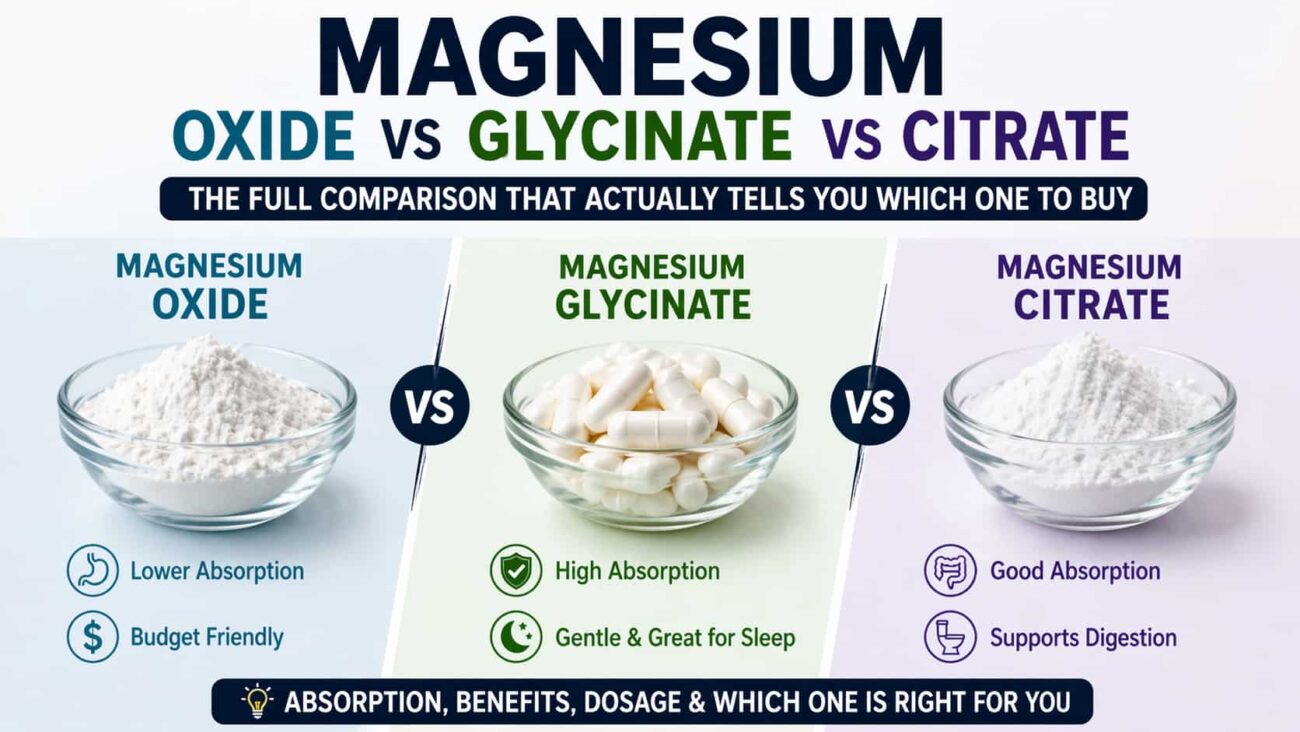
Magnesium Oxide vs Glycinate vs Citrate: The Full Comparison That Actually Tells You Which One to Buy
Walk into any pharmacy or supplement store and you’ll find at least half a dozen different forms of magnesium on the shelf. They all claim to support muscle function, sleep, and energy. They all look the same from the front of the bottle. But the differences between them are not cosmetic — they determine whether the magnesium you’re taking is actually getting into your cells, or passing straight through you.
The debate between magnesium oxide vs glycinate alone is one of the most searched supplement comparisons online — and for good reason. Oxide is the cheapest, most widely sold form. Glycinate is the most bioavailable and gentle on the gut. Citrate sits in between. Choosing the wrong one could mean taking a supplement for months that’s doing almost nothing.
This guide gives you the complete picture: how each form is made, how well each is absorbed, what each is clinically useful for, who should take which, and the dosage numbers that actually matter.
Magnesium glycinate has the highest bioavailability and gentlest GI profile — best for sleep, anxiety, and daily supplementation. Magnesium citrate absorbs well and has a mild laxative effect — best for constipation and general magnesium repletion. Magnesium oxide has the lowest absorption (~4%) but the highest elemental magnesium content by weight — primarily used for short-term digestive relief, not systemic repletion.
Why the Form of Magnesium Matters More Than the Dose on the Label
Magnesium supplements don’t deliver elemental magnesium by itself. The mineral is always bound to a companion molecule — an organic acid, an amino acid, or a mineral salt — that determines how the compound behaves in the digestive tract and how much of that magnesium reaches the bloodstream.
This is called bioavailability — the proportion of a nutrient that is actually absorbed and available for the body to use. For magnesium, the bioavailability difference between forms is dramatic:
A supplement labeled “500 mg magnesium oxide” delivers roughly 20 mg of usable magnesium to your cells. A “200 mg magnesium glycinate” capsule may deliver 160–180 mg. The gap is not a rounding error — it is the difference between a supplement that works and one that doesn’t.
The other critical concept is elemental magnesium content — the actual weight of pure magnesium within the compound. Oxide contains the highest percentage of elemental magnesium by weight (60%), but absorbs the least. Glycinate contains less elemental magnesium per gram (14%) but delivers far more of it to the bloodstream. This is why label comparison by milligrams alone is meaningless.
Magnesium Oxide, Citrate, and Glycinate: What Each One Actually Is
Formed by burning magnesium with oxygen. The simplest, cheapest, and most abundant form in the mass market. High elemental magnesium content (60%) but extremely poor absorption — most is excreted rather than absorbed.
Magnesium bound to citric acid. More soluble in water than oxide, making it significantly better absorbed. Produces osmotic effects in the bowel — drawing water in, which softens stool and stimulates movement. Widely sold for constipation and general supplementation.
Magnesium chelated to glycine, a calming amino acid. Absorbed through amino acid transport pathways — bypassing the osmotic route that causes diarrhea. Highest bioavailability, gentlest on the gut, and the glycine component adds complementary sleep and anxiety benefits independently.
Magnesium Oxide vs Glycinate vs Citrate: Full Head-to-Head Comparison
| Comparison Factor | 🟣 Oxide | 🔵 Citrate | 🟢 Glycinate |
|---|---|---|---|
| Bioavailability | ~4% (very poor) | ~55–65% (good) | ~80–90% (excellent) |
| Elemental Mg by weight | 60% | 16% | 14% |
| Absorption mechanism | Passive diffusion (limited) | Osmotic + passive diffusion | Amino acid transport channels |
| GI side effects | Strong laxative effect; diarrhea likely at higher doses | Mild-moderate laxative effect; loose stool possible | Minimal — well tolerated even at higher doses |
| Best for sleep | No | Moderate (Mg benefit only) | Yes — Mg + glycine synergy |
| Best for constipation | Yes — potent osmotic laxative | Yes — gentler laxative effect | No (no laxative effect) |
| Best for anxiety/mood | No | Limited | Yes — glycine has independent calming effects |
| Best for muscle cramps | Inefficient — low absorption | Moderate | Yes — high absorption reaches muscle tissue |
| Best for Mg deficiency | No — most passes unabsorbed | Yes — reasonable repletion | Yes — most efficient repletion |
| Suitable for IBS / sensitive gut | No | Caution — may trigger urgency | Yes — first choice for IBS patients |
| Typical supplemental dose (elemental Mg) | 200–500 mg oxide (8–20 mg absorbed) | 200–400 mg/day | 200–400 mg/day |
| Cost per meaningful dose | Very low — but poor value due to low absorption | Moderate | Higher upfront — better cost-per-absorbed-mg |
| Available form | Capsule, tablet, powder | Capsule, tablet, liquid, powder | Capsule, tablet, powder |
| ICD-10 relevance (deficiency code) | E61.2 — Magnesium deficiency (applies to all forms) | ||
Magnesium Oxide: When It’s the Right Choice — and When It’s a Waste of Money
Magnesium oxide has earned a reputation as the “bad” magnesium, and largely, that reputation is deserved for supplementation purposes. Its bioavailability of approximately 4% has been demonstrated in multiple absorption studies — meaning the vast majority of what you swallow is never absorbed into circulation.
So why is it still on every pharmacy shelf and in most cheap multivitamins? Because it is inexpensive to produce, has a high elemental magnesium percentage by weight, and — critically — it delivers a measurable laxative effect at the doses used, which satisfies short-term consumer expectations.
Legitimate Use Cases for Magnesium Oxide
- Acute constipation relief: Magnesium oxide’s powerful osmotic effect — drawing water into the bowel — makes it effective as a short-term laxative. Milk of Magnesia (magnesium hydroxide, a close relative) operates on the same principle.
- Heartburn and acid indigestion: As an antacid, magnesium oxide neutralizes stomach acid effectively and is used clinically for this purpose.
- Bowel prep before colonoscopy: Higher-dose magnesium oxide preparations are used to clear the bowel before endoscopic procedures.
Magnesium Citrate: The Versatile Middle Ground
Magnesium citrate hits a useful sweet spot: meaningfully better absorbed than oxide, more affordable than glycinate, and with a secondary benefit (promoting bowel regularity) that makes it a natural fit for people managing both magnesium deficiency and constipation at the same time.
Its absorption operates through a combination of mechanisms — the citrate anion improves solubility in the digestive tract, and the compound can be absorbed through both active transport and passive diffusion. Research comparing magnesium forms consistently places citrate well above oxide in raising serum and urinary magnesium levels.
Best-Fit Scenarios for Magnesium Citrate
- General magnesium supplementation when cost is a factor and GI tolerance isn’t sensitive
- Chronic constipation management — particularly useful for people who need both magnesium repletion and improved bowel regularity
- Kidney stone prevention — citrate directly inhibits calcium oxalate crystallization in the kidneys, which is why urologists frequently recommend magnesium citrate for patients prone to calcium-oxalate stones
- Post-workout recovery — good absorption at a lower price point than glycinate
- Pre-sleep use at low-moderate doses — some sleep benefit from the magnesium, though without glycine’s additional neurological calming action
For people managing both magnesium deficiency and muscle cramping, our comprehensive guide on the best magnesium supplements for cramping evaluates which forms work best across different cramp types — from nocturnal leg cramps to exercise-induced cramping — with specific dosage guidance.
Magnesium Glycinate: The High-Absorption Form With a Bonus
Magnesium glycinate is widely considered the gold standard form for therapeutic supplementation — and for good reason. Its absorption advantage over oxide is not marginal; it is twenty times more bioavailable per milligram taken.
The mechanism behind this superiority matters: glycinate (the glycine salt) is absorbed through dipeptide transport channels in the intestinal wall — the same pathway used to absorb dietary amino acids. This bypasses the osmotic mechanism that causes diarrhea with oxide and citrate at higher doses, making glycinate well-tolerated even at supplemental doses of 300–400 mg elemental magnesium daily.
The Glycine Advantage
Glycine is not a passive carrier molecule. It is an inhibitory neurotransmitter with independent effects on the nervous system:
- Glycine activates NMDA receptors in a modulatory way that promotes relaxation without sedation
- Clinical research has shown that 3g of glycine before bed improves subjective sleep quality and reduces next-day fatigue — through a mechanism distinct from magnesium’s effect on GABA receptors
- Glycine also plays a role in collagen synthesis and has demonstrated anti-inflammatory properties in human studies
This means magnesium glycinate delivers two therapeutic agents simultaneously — magnesium and glycine — both of which independently support sleep quality, nervous system regulation, and mood stability.
Best-Fit Scenarios for Magnesium Glycinate
- Sleep disorders and poor sleep quality — the combination of magnesium + glycine is the most evidence-backed supplemental approach for improving sleep onset and sleep architecture
- Anxiety, stress, and nervous system dysregulation
- PMS symptoms — muscle cramping, mood changes, and sleep disruption in the premenstrual phase all respond well to the glycinate form
- Magnesium deficiency with GI sensitivity — first choice for people with IBS, Crohn’s disease, or any condition affecting gut permeability
- Long-term daily supplementation — highest tolerability for ongoing use
- Cardiovascular support — effective magnesium delivery to cardiac and vascular smooth muscle
Our in-depth guide on magnesium glycinate for sleep and relaxation covers the clinical evidence behind this form specifically — including dosing protocols, timing, and what to realistically expect within the first 2–4 weeks of use.
If you’re new to glycinate and concerned about side effects, our dedicated guide on magnesium glycinate side effects explains what reactions are normal, which are worth monitoring, and how to avoid the most common mistakes with dosing.
Which Magnesium Form Is Right for You? The Complete Decision Guide
- For sleep and anxiety: Magnesium glycinate — best absorption, glycine co-benefit
- For constipation: Magnesium citrate or oxide — osmotic laxative effect
- For muscle cramps: Magnesium glycinate or citrate — high cellular delivery
- For kidney stone prevention: Magnesium citrate — citrate inhibits stone formation
- For sensitive stomachs / IBS: Magnesium glycinate — no osmotic effect
- For correcting deficiency fast: Magnesium glycinate — most efficient systemic repletion
- For budget supplementation: Magnesium citrate — best value for absorption vs cost
You struggle to fall asleep, wake at night, or feel wired but tired. Anxiety contributes to poor sleep.
Magnesium GlycinateInfrequent or difficult bowel movements. Want laxative + magnesium repletion in one supplement.
Magnesium CitrateLeg cramps at night, exercise-induced cramps, or PMS-related muscle tension.
Magnesium GlycinateChronic stress, generalised anxiety, low mood, or stress-related headaches and tension.
Magnesium GlycinateCardiovascular support, mild hypertension management, or general cardiac health maintenance.
Magnesium CitrateLab-confirmed low serum magnesium. Need efficient repletion without GI side effects.
Magnesium GlycinateMagnesium Deficiency: Why the Right Form Is Essential for Correction
Magnesium deficiency is significantly more common than most people — and many clinicians — realise. Estimates suggest that up to 50% of people in the US consume less than the recommended daily allowance, and standard serum magnesium tests are poorly sensitive because only about 1% of total body magnesium circulates in the blood.
This matters for form selection because correcting a genuine deficiency requires that magnesium actually reach the intracellular compartment — not just circulate briefly in the blood. Only well-absorbed forms achieve this reliably.
Common signs of magnesium deficiency that drive people to search for supplementation include:
- Persistent muscle cramps and twitching (particularly eyelid twitches and nocturnal leg cramps)
- Poor sleep quality and difficulty staying asleep
- Fatigue and low energy despite adequate sleep
- Irritability, anxiety, and mood instability
- Headaches and migraines
- Heart palpitations or irregular heartbeat
- Numbness or tingling in extremities
- Constipation (magnesium is essential for smooth muscle function in the gut)
If you recognize multiple symptoms from this list, our guide on symptoms of lacking magnesium covers all 12 clinical warning signs with the biological mechanism behind each — including which symptoms respond fastest to supplementation and which may take longer to resolve.
For specific dosage guidance — including RDA values by age and sex, therapeutic ranges, and upper tolerable limits — our magnesium dosage guide provides all the numbers you need to supplement correctly without risk of over-supplementation.
Magnesium Dosage by Form: What the Evidence Actually Recommends
| Form | Daily Dose (elemental Mg) | Product Dose Range | Best Timing |
|---|---|---|---|
| Magnesium Oxide | ~20–40 mg absorbed (from 500–1000 mg oxide) | 250–500 mg oxide tablets | With food; laxative doses at night |
| Magnesium Citrate | 150–400 mg elemental Mg | 200–500 mg citrate capsule/powder | With food; bowel prep doses on empty stomach |
| Magnesium Glycinate | 200–400 mg elemental Mg | 300–600 mg glycinate capsule | Evening / 1 hr before bed for sleep benefit |
Can You Take Multiple Magnesium Forms Together?
Some practitioners recommend a combination approach — for example, magnesium citrate in the morning for general repletion and bowel regularity, and magnesium glycinate in the evening for sleep and nervous system support. This is clinically reasonable and not contraindicated.
The key is keeping total elemental magnesium within the tolerable upper limit (350 mg supplemental per day from all sources, not including dietary magnesium). Splitting the dose across the day also reduces the GI burden of any one form.
Avoid combining magnesium oxide with other forms for repletion purposes — the poor absorption of oxide means you’re essentially just adding laxative risk without meaningful magnesium benefit.
How to Read a Magnesium Supplement Label Correctly
- Always look for “elemental magnesium” disclosure. Reputable brands list both the compound weight and the elemental magnesium content. If only the compound weight is listed, use these conversions: oxide = ×0.60; citrate = ×0.16; glycinate = ×0.14.
- Third-party certification matters. Look for NSF International, USP Verified, or Informed Sport seals. Mineral supplement purity is not guaranteed by FDA oversight alone.
- “Magnesium bisglycinate” = magnesium glycinate. Some brands use this term to indicate the chelated form — it is the same compound.
- Avoid magnesium oxide in multivitamins for deficiency correction. Most mass-market multivitamins use oxide as their magnesium source because it is cheapest and contributes the most milligrams per gram. It will not meaningfully contribute to your magnesium levels.
- Check for unnecessary fillers. Quality magnesium supplements should not require titanium dioxide, synthetic dyes, or shellac coatings. These additives serve the manufacturer, not the consumer.
The National Institutes of Health Office of Dietary Supplements maintains the most authoritative and regularly updated fact sheet on magnesium — covering RDAs, food sources, deficiency indicators, drug interactions, and form-specific bioavailability data. The European Food Safety Authority (EFSA) publishes independent dietary reference values for magnesium with particular attention to upper tolerable intake levels across age groups.
Frequently Asked Questions
Conclusion: Magnesium Oxide vs Glycinate vs Citrate — The Bottom Line
When you compare magnesium oxide vs glycinate — or any two forms side by side — the differences aren’t minor. They determine whether your supplement is working at all. Oxide, despite its ubiquity and low price, absorbs at roughly 4% — making it an antacid and laxative, not a meaningful source of systemic magnesium. Citrate sits in a genuinely useful middle ground, with good absorption and additional bowel benefits. Glycinate is the form that delivers the most magnesium where it needs to go, with the best GI tolerance and the added benefit of glycine’s calming action.
If you are taking magnesium for sleep, anxiety, muscle cramps, or deficiency correction — glycinate is the clearest recommendation the evidence supports. If you’re managing constipation alongside magnesium needs, citrate earns its place. If a product contains oxide and you’re not using it as a laxative, it’s probably not doing what you think it is.
Know what form you’re taking, why you’re taking it, and whether the dose on the label reflects what’s actually being absorbed. That’s how magnesium supplementation actually works.
- Magnesium Glycinate for Sleep and Relaxation: Benefits, Dosage & Safety
- Magnesium Glycinate Side Effects: What You Need to Know Before You Take It
- 7 Best Magnesium Supplements for Cramping: Dosage & Relief
- Magnesium Dosage Guide: How Much Should You Take Daily?
- Symptoms of Lacking Magnesium: 12 Warning Signs You Shouldn’t Ignore
- Best Magnesium Supplements for Anxiety: 7 Evidence-Based Options
- Magnesium Glycinate vs Citrate: Which Is Better for Sleep & Constipation?
This article is for informational and educational purposes only. It does not constitute medical advice or a recommendation to start, stop, or change any supplement regimen. Always consult a qualified healthcare professional before supplementing, especially if you take prescription medications or have a kidney condition. See our full medical disclaimer.
About The Author
